
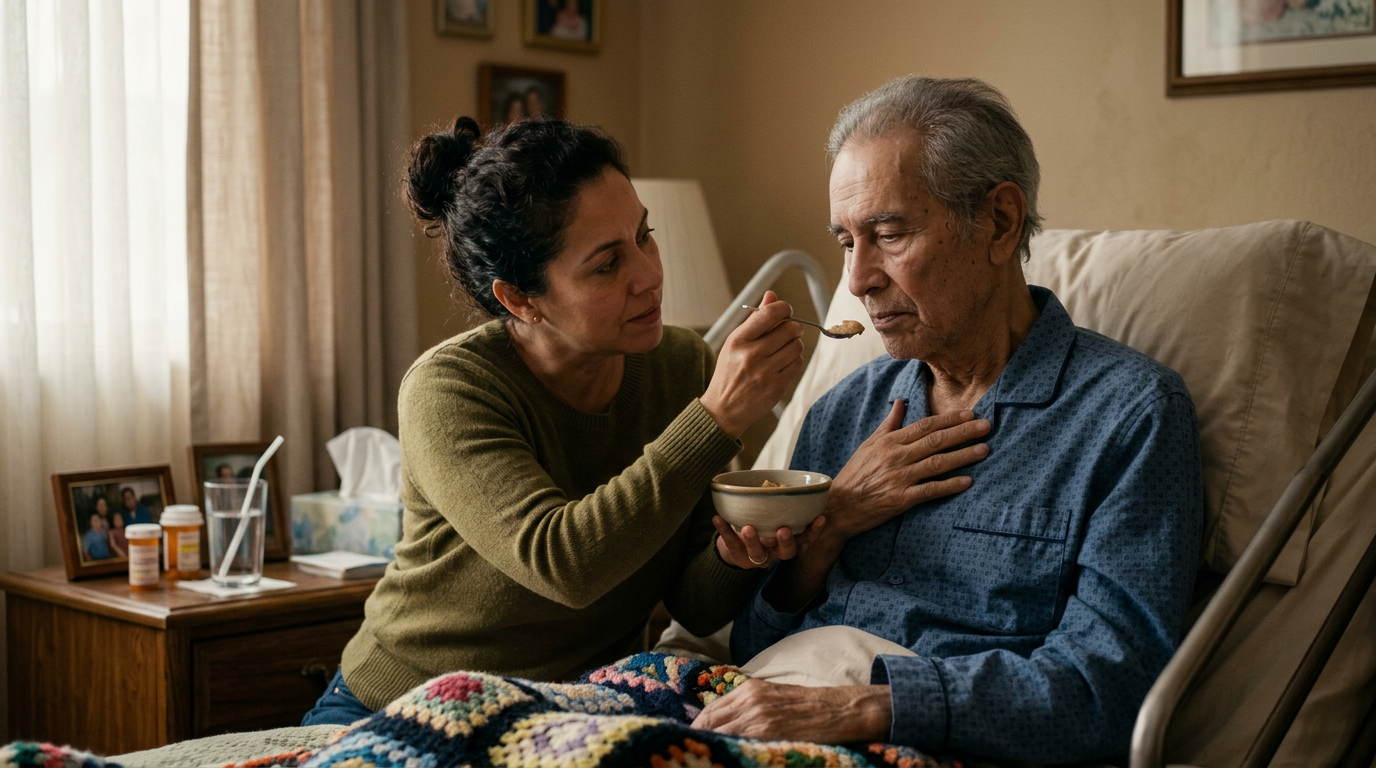
Few things in caregiving feel as distressing as watching someone you love stop eating. Food is one of the most fundamental ways we take care of people. We cook for them. We bring meals. We sit together at the table. When the person you’re caring for turns away from food—or can’t keep it down, or simply won’t open their mouth—it can feel like you’re failing them.
We want to be very direct with you: you are not failing them. And they are not giving up, being difficult, or refusing to try. What’s happening in their body is something neither of you can control, and understanding why it’s happening can make an enormous difference in how you navigate this part of the journey.
Why Do Hospice Patients Lose Their Appetite?
Loss of appetite in serious illness is not the same thing as choosing not to eat. It’s not stubbornness, and it’s not depression—though both of those things can exist alongside it. What’s happening is medical, and it has a name: anorexia-cachexia syndrome.
Anorexia, in this context, means a loss of the body’s natural drive to eat. Cachexia refers to the progressive loss of muscle and body weight that happens in advanced illness. Together, they form a syndrome that is driven by the disease itself—not by a lack of willpower or effort.
Here is what’s actually going on: as a serious illness progresses, the body releases inflammatory chemicals called cytokines. These chemicals interfere with the brain’s hunger signals, alter how the body processes nutrients, and change the way food tastes and smells. Many patients experience early satiety—feeling full after just a few bites. Some develop an aversion to meat or other foods they used to enjoy. Others feel nauseated at the sight or smell of food.
This happens across a wide range of conditions: cancer, heart failure, COPD, kidney disease, dementia, and others. It’s estimated that cachexia affects the majority of patients with advanced cancer, and it’s present in many other terminal illnesses as well. Your loved one’s body is not processing food the way a healthy body does. The machinery has changed. Pushing more food into a system that can no longer use it doesn’t fix the problem—and it can create new ones.
Why Forcing Food Can Cause Harm
This is the part that’s hardest for families to hear, and we want to be honest about it: continuing to push food on a patient whose body is shutting down can cause real, physical harm.
As illness progresses, many patients lose the ability to swallow safely. The muscles that coordinate swallowing weaken, and the reflexes that protect the airway become less reliable. When food or liquid enters the airway instead of the esophagus, it’s called aspiration. Aspiration can cause choking, and it can lead to aspiration pneumonia—a serious and painful lung infection. For a patient who is already fragile, this can significantly increase suffering.
Even when a patient can still technically swallow, forcing food into a body that can no longer process it properly can cause nausea, vomiting, bloating, and abdominal pain. The digestive system slows down as part of the dying process. Food that would normally move through the stomach and intestines sits there, causing discomfort.
We understand the fear behind the impulse to keep feeding. No one wants to feel like they’re “starving” someone they love. But this is one of the most important distinctions we can draw for you: what is happening is not starvation. Starvation means a healthy body is being deprived of food. In your loved one’s case, the body is actively shutting down its own demand for food. The hunger signals are gone. The disease has changed how the body works. Withholding food instead of forcing it on them is not cruelty—it’s compassion.
What About Feeding Tubes and Artificial Nutrition?
Many families ask about feeding tubes as a way to ensure their loved one is getting nutrition. This is a natural question, and it deserves an honest answer.
Research has consistently shown that artificial nutrition—whether through a tube inserted through the nose or directly into the stomach—does not improve quality of life, extend survival, or reduce suffering in patients with advanced illness. In patients with advanced dementia, studies have found no difference in life expectancy between those who are tube-fed and those who receive careful hand feeding. Both the American Geriatrics Society and the American Academy of Hospice and Palliative Medicine recommend against feeding tubes for patients with advanced dementia.
In fact, tube feeding can introduce its own set of complications: increased risk of aspiration, infections at the tube site, diarrhea, bloating, and the discomfort of having a tube in place that the patient may try to pull out—sometimes requiring physical restraints to prevent removal. For many patients, tube feeding adds burden without adding benefit.
This doesn’t mean nutrition doesn’t matter earlier in the hospice journey. If your loved one still has an appetite and can eat comfortably, food can absolutely be a source of pleasure and comfort. The guidance here applies specifically to the point where the body has stopped asking for food—which is a different situation entirely.
What Can Families Do Instead?
When eating is no longer possible or desired, caregiving doesn’t stop. It shifts.
Follow your loved one’s lead. If they want to eat, offer food. If they don’t, don’t push. Let them decide what sounds good, even if it’s just a few bites of something specific or a sip of a favorite drink. There’s no minimum they need to meet.
Offer small amounts of what they enjoy. A spoonful of ice cream, a popsicle, a sip of juice, a piece of hard candy. At this stage, the goal is not nutrition—it’s pleasure and comfort. If your loved one takes two bites and is done, that’s enough.
Keep the mouth comfortable. When a patient stops drinking, the mouth and lips can become dry and uncomfortable. Use a damp washcloth, sponge-tipped swabs, lip balm, or ice chips to keep the mouth moist. This is one of the most meaningful things you can do for their comfort.
Find other ways to nurture. Food is one way to show love, but it’s not the only way. Sitting with your loved one, holding their hand, reading to them, playing music they enjoy, talking to them even when they can’t respond—these things matter. They matter enormously.
Talk to your hospice team about medications. Nausea, constipation, mouth sores, or medication side effects may be contributing to your loved one’s lack of appetite. Some of these are treatable. Your hospice team can assess whether anything reversible is making things worse.
The Guilt Is Normal. The Love Is Clear.
If you’re feeling guilty about not being able to feed someone you love, please know that this guilt is one of the most common experiences in hospice caregiving. We hear it from almost every family. It comes from a place of deep love and a fundamental instinct to nourish and protect.
But the most protective thing you can do right now is to let go of the idea that food equals care. Your presence is care. Your attention to their comfort is care. Your willingness to sit in this hard, uncertain space and still show up—that is care at its most profound.
Your loved one is not hungry. Their body has moved past that. And honoring where they are—rather than where you wish they were—is one of the bravest and most loving things a caregiver can do.
Written by The Hospice Care Bridge TeamWith over a decade of hospice nursing experience, because families deserve better